

Flat Roof Lifespan: EPDM vs GRP vs Felt Compared
Short answer: flat roof lifespan depends mainly on which system you choose — a felt flat roof typically lasts 10–20 years, EPDM rubber 20–30 years, and GRP fibreglass 20–30 years or more. The material matters, but installation quality, drainage and maintenance matter just as much — a badly detailed EPDM roof will fail before a well-installed felt one.
This comparison is written by Golden Roofing Expert Ltd, a London roofing contractor, based on the flat roofs we install and repair across the capital.
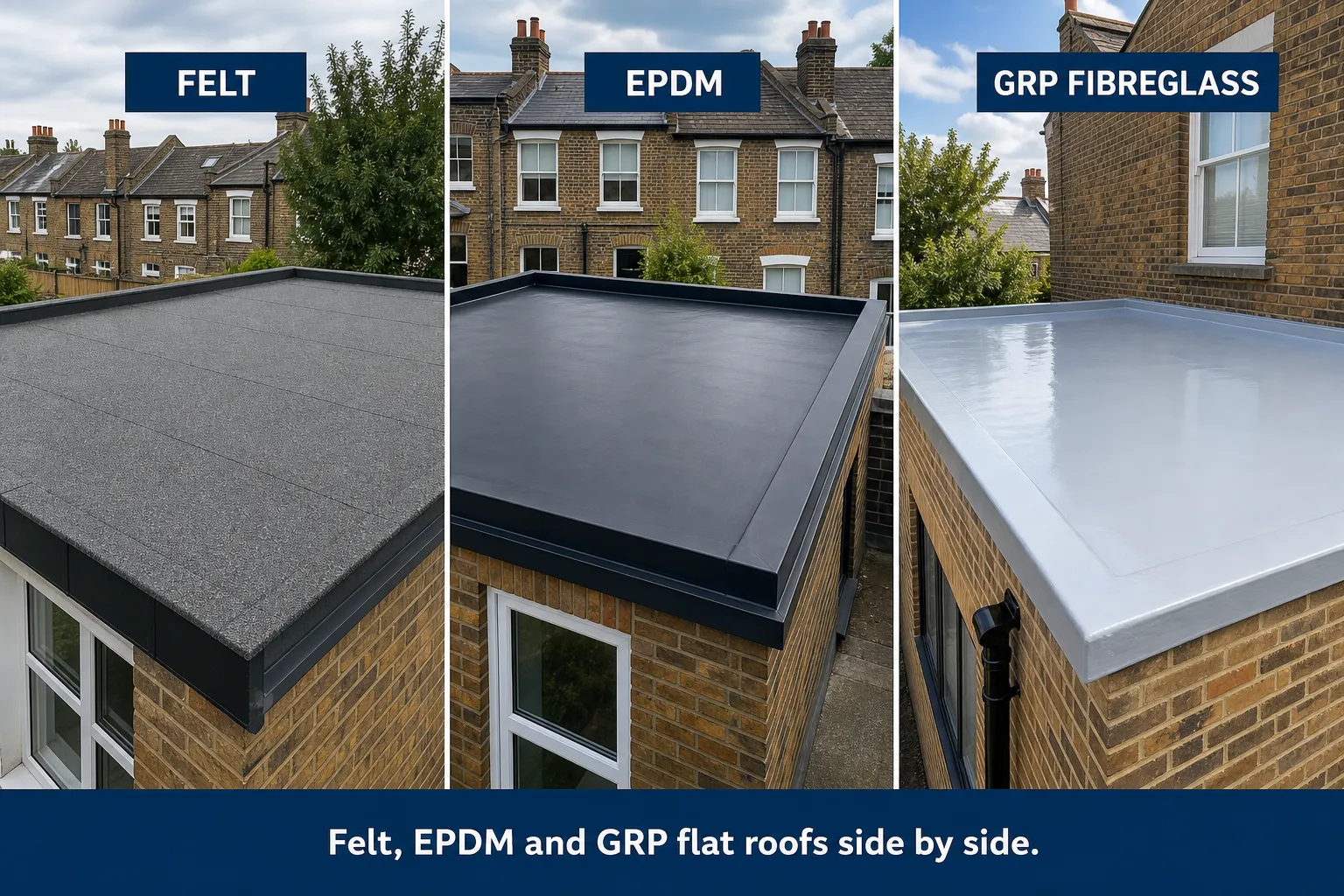
Flat roof lifespan at a glance
| System | Typical lifespan | Relative cost | Best for |
|---|---|---|---|
| Traditional felt (torch-on) | 10–20 years | £ | Budget jobs, garages, sheds |
| High-performance felt | 15–25 years | ££ | Most residential flat roofs |
| EPDM rubber | 20–30 years | ££ | Large, simple, low-pitch roofs |
| GRP fibreglass | 20–30+ years | £££ | Complex shapes, balconies, walkways |
| Mastic asphalt | 30–40+ years | £££ | Foot traffic, seamless finishes |
See our flat roofing service for the systems we install and our asphalt roofing page for the heavier end of the market.
Felt flat roofs
What it is: layers of bitumen-saturated felt bonded together, traditionally torch-applied, to build up a waterproof covering.
Strengths: the cheapest option, widely understood, quick to install, easy to repair in small sections.
Weaknesses: the shortest lifespan of the three, vulnerable to blistering and splitting at laps, and less tolerant of foot traffic. Torch-on application also carries a fire risk during installation, which matters on occupied buildings.
Verdict: a reasonable choice where budget is the deciding factor, or where the roof is sheltered and rarely walked on. Modern high-performance felts with a polyester base are a genuine step up from the old 3-layer felt most people remember.
EPDM rubber flat roofs
What it is: a single-ply synthetic rubber membrane, usually supplied as one large sheet, glued or mechanically fixed and sealed at the edges and penetrations.
Strengths: long lifespan, excellent flexibility so it tolerates thermal movement, fewer seams than felt, and it performs well in cold weather. Because it can arrive as a single sheet, there are fewer joints to leak.
Weaknesses: it is not fully seamless on complex roofs — penetrations and edges still need detailing, and poorly glued laps are the most common cause of failure we see. It also does not look as sharp on a visible feature roof.
Verdict: arguably the best value for large, simple, low-pitch roofs. On a big flat roof with few obstructions, it is hard to beat on cost per year of life.
GRP fibreglass flat roofs
What it is: glass-reinforced polyester resin, applied in layers on site to form a rigid, seamless surface.
Strengths: genuinely seamless, so it handles complex shapes, awkward corners and many penetrations well. Tough underfoot, and available in a range of finishes. Once cured it is very durable.
Weaknesses: the most sensitive of the three to installation conditions. Resin needs the right temperature and mixing, and if it is applied over a deck that moves or is damp, it will crack. It is also the hardest to repair cleanly if it is damaged.
Verdict: ideal for complex roofs, balconies and areas with foot traffic, provided it is installed by people who do it regularly and the deck is solid and dry.
Why installation matters more than the material
We are called to far more flat roofs that failed because of poor detailing than because the wrong material was chosen. The recurring culprits are:
- No adequate fall — water sits on the roof instead of running to the outlet.
- Bad upstand detailing — the waterproofing does not run high enough up the wall.
- Blocked or undersized outlets — water backs up in heavy rain.
- Poor substrate preparation — the covering is laid over a damp or moving deck.
- Incompatible materials — a patch that does not bond to the original roof.
Any of these will shorten a roof’s life regardless of whether you paid for felt or fibreglass. That is why we survey and specify before quoting rather than working backwards from a price.
A flat roof that failed twice in Camden
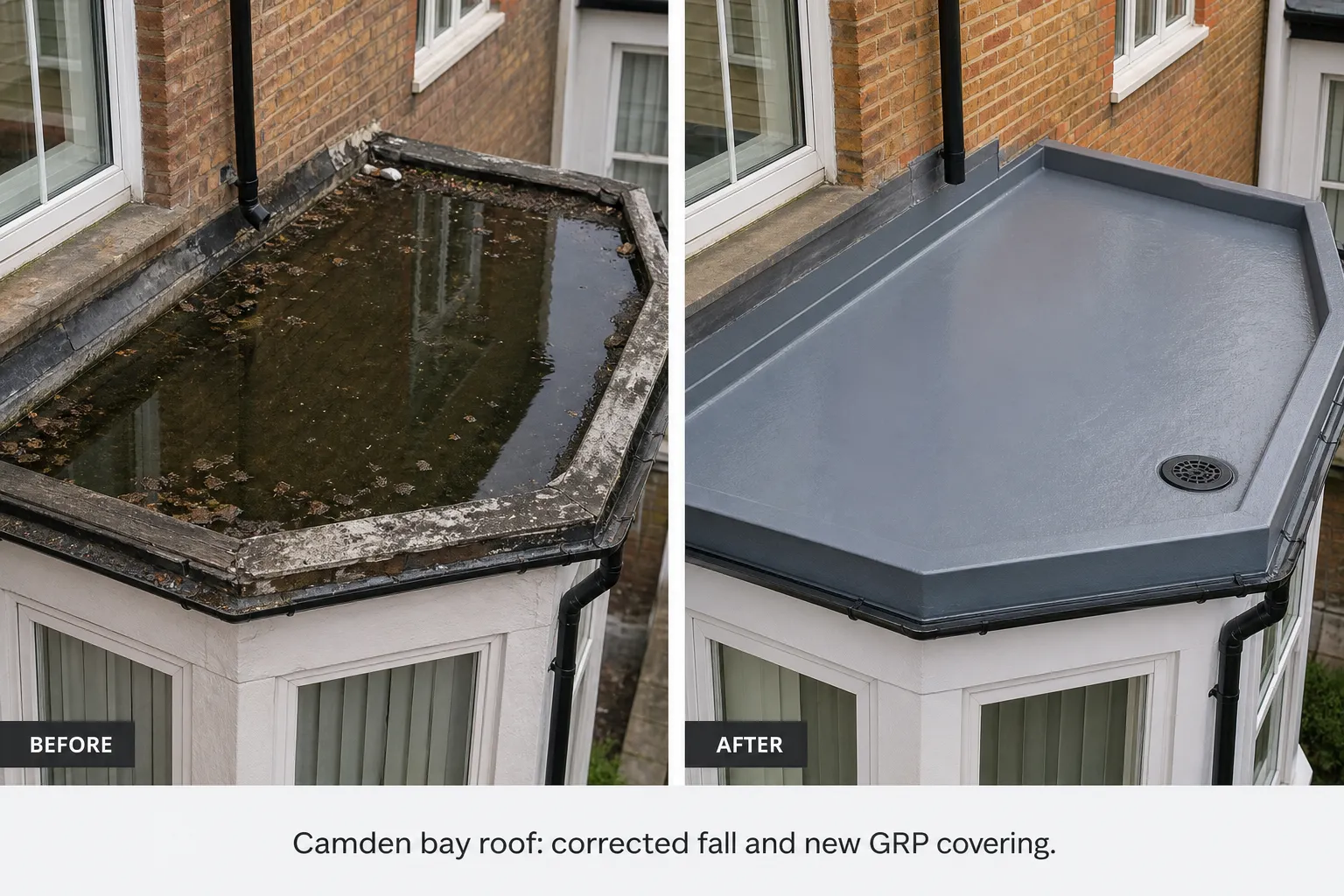
An owner of a ground-floor flat in Camden had a flat roof over a bay window replaced twice in six years — once in felt, once in a “better” membrane — and it still leaked into the bedroom below. By the time they called us they had lost confidence in the whole idea of repairing it.
The problem was not the material. Both previous roofs had been laid with almost no fall, and the outlet sat slightly above the surrounding surface, so water pooled permanently in one corner. The upstand to the brickwork was also too low, so during heavy rain the water simply rose over it and into the wall.
We rebuilt the roof properly: corrected the fall to the outlet, raised and re-dressed the upstand, replaced the outlet with a correctly sized one and finished the roof in fibreglass, which suited the small, awkward bay shape with its several corners. The most important change cost almost nothing — the roof now drains.
The flat has been dry through every winter since, which is a reminder that lifespan claims mean nothing if the water cannot get off the roof.
How to make any flat roof last longer
- Clear leaves and debris from outlets and gullies at least twice a year — more if you have trees nearby.
- Have the roof inspected every year or two, ideally before winter.
- Deal with small defects early; a split lap costs far less to fix than a saturated deck.
- Keep foot traffic to a minimum unless the roof is designed for it.
- Never let anyone walk on it in very cold weather, when membranes are most brittle.
Most flat roof failures follow severe weather, so it pays to watch Met Office weather warnings and inspect the roof once a storm has passed.
Our roof maintenance service covers scheduled inspections and gutter clearing, and our roof leak repair service deals with leaks that have already started.
Flat roof lifespan FAQs
How long does a flat roof last?
Felt lasts around 10–20 years, EPDM and GRP around 20–30 years, and mastic asphalt 30 years or more. Installation quality, drainage and maintenance can swing these figures by a decade in either direction.
Which flat roof lasts longest?
Of the common systems, mastic asphalt and GRP tend to last longest, and asphalt is the most tolerant of foot traffic. For a simple large roof on a budget, EPDM often gives the best cost per year.
Is felt cheaper than EPDM?
Yes, felt is cheaper up front, but EPDM usually costs less per year of service because it lasts longer. If you plan to stay in the property, that difference usually favours EPDM or GRP.
Can I put a new flat roof over the old one?
Sometimes — if the deck and existing layers are sound, an overlay can save money and waste. Whether it is appropriate depends on weight, moisture and the state of the structure, so it always follows a survey.
Does a flat roof need a minimum fall?
Yes. A fall is what stops water pooling, and inadequate fall is the single most common reason flat roofs fail early. The building regulations set out the minimum, and we design to it on every job.
Get advice on your flat roof
If you are choosing between systems, or trying to work out whether your roof is genuinely at the end of its life, send us a few photographs and the approximate size. We will tell you honestly which system suits your building. Start with our flat roofing service or get in touch via our contact page.
Golden Roofing Expert Ltd is vetted through Checkatrade, Which? Trusted Trader and TrustATrader (TT24074). Guarantees vary by system and are confirmed in writing in your quotation.